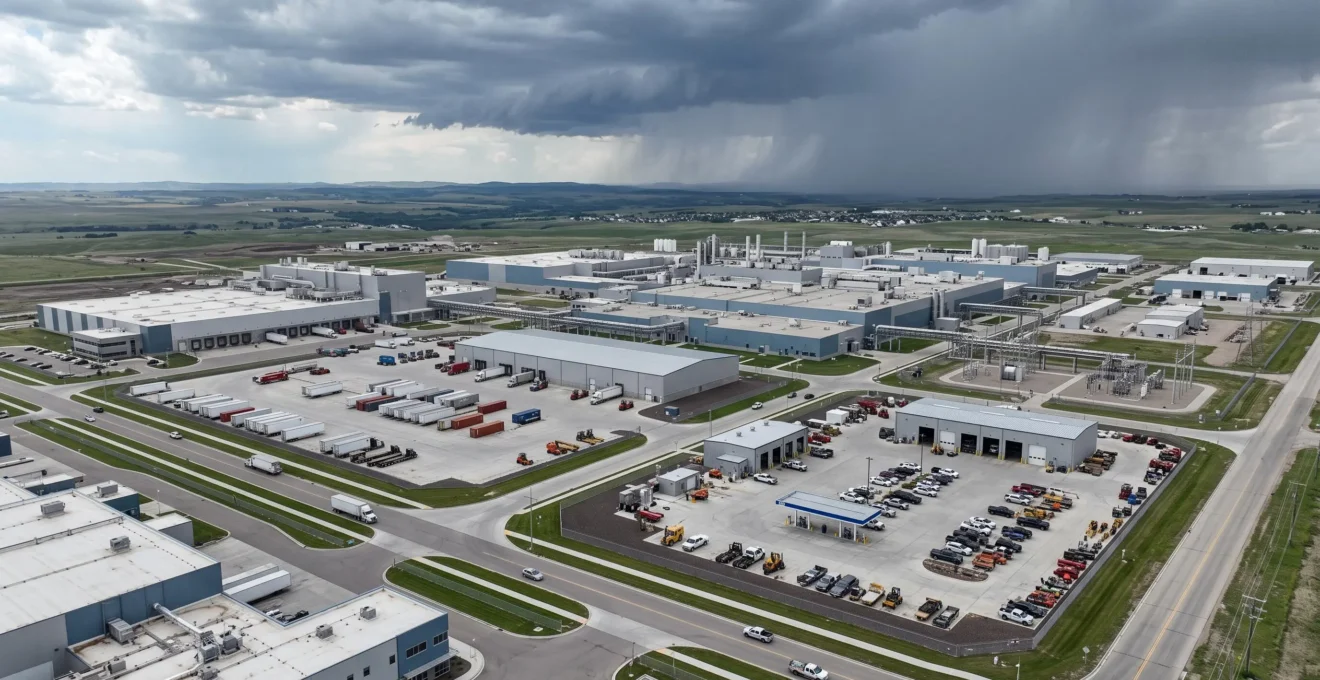
Lightning warning zones across a large industrial site should be defined around worker exposure, shelter access and the time required to stop operations safely—not simply around property boundaries. A loading yard, an elevated maintenance area and a remote utility installation may need different warning lead times, even when they belong to the same facility.
The practical approach is to map exposed activities, identify suitable shelters, establish monitoring boundaries, calculate response times and coordinate site-wide and local alerts. The resulting zones must help workers take protective action before dangerous conditions reach them, while allowing immediate shelter decisions whenever thunder or visible lightning indicates danger.
Map exposure and safe shelter across the site
The US National Weather Service’s workplace lightning safety guidance identifies outdoor activities, elevated work and conductive materials as exposure concerns. It also emphasizes giving workers enough warning to reach appropriate shelter, making evacuation access a starting point for site zoning.
Begin with a current site map showing where personnel work and where they can safely take shelter. Relevant locations include loading yards, crane operating areas, rooftops, outdoor maintenance points, storage facilities, utility installations and remote substations. Workers handling explosives or other especially hazardous operations may require additional shutdown procedures.
For each area, establish three practical details: who is exposed, where suitable shelter is located and how long protective action takes. Include the time needed to secure equipment, communicate a stop-work instruction and reach the shelter—not merely the walking distance.
Remote contractors and temporary work crews must also be included. A building marked on the map is not automatically an appropriate shelter: its construction, enclosure and accessibility matter. Open-sided structures and exposed equipment should not be treated as safe alternatives to substantial enclosed buildings.
Define the warning zones and their coverage
Industrial lightning zoning becomes clearer when three geographic functions are distinguished:
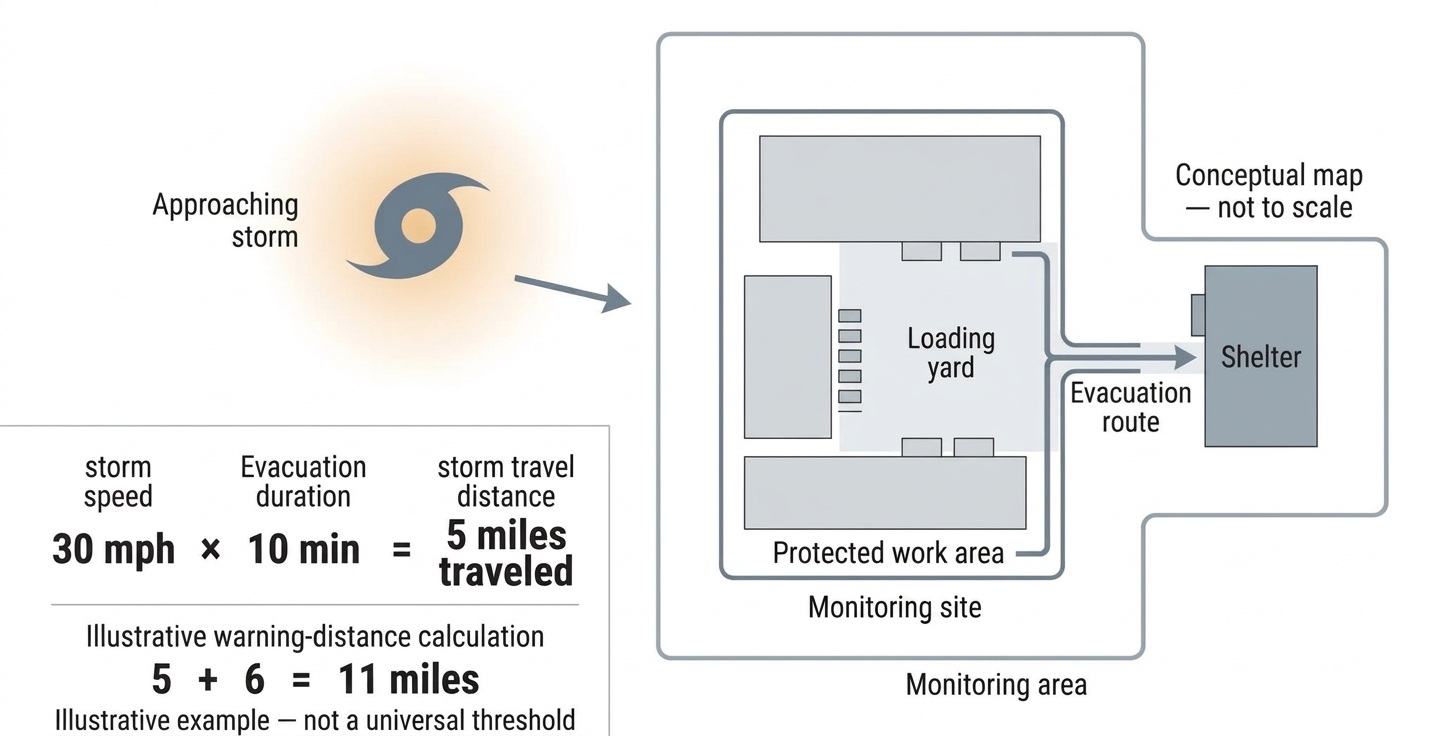
- Protected work area: the location containing people or activities that require a safety response.
- Nearby hazard area: the surrounding region where lightning activity may require stopping exposed operations.
- Monitoring area: a wider region observed for approaching thunderstorms so warnings can begin early enough.
These are practical planning concepts, not three universally prescribed regulatory boundaries. The monitoring area may extend beyond the industrial property, while several work areas may share some boundaries or monitoring information.
The next decision is whether to use one site-wide warning, separate local zones or a coordinated combination.
| Arrangement | Best operational fit | Main limitation |
|---|---|---|
| Site-wide warning | Shared exposure and a common stop-work instruction | May not reflect different shelter times or localized activities |
| Local warning zones | Separated work areas with different tasks and response times | Requires clear coordination and reliable message routing |
| Coordinated hybrid | Central hazard oversight with defined local operational actions | Needs explicit rules when zones overlap or hazards affect the whole site |
A local zone should never be interpreted as permission to remain outdoors when thunder is audible or lightning is visible. The configuration defines how advance warnings are organized; it does not override immediate signs of danger.
On a large manufacturing campus, loading yards, maintenance areas and production units may need different alert lead times. Once these requirements are mapped, METEORAGE’s approach to industrial lightning risk prevention illustrates how exposure assessment, thunderstorm alerts, live monitoring and lightning data integration can support site-specific decisions. These services can inform an operating procedure, while shelter access, warning thresholds and stop-work responsibilities still need to be defined for the actual site.
Set warning lead time from actual response needs
A warning boundary should provide enough time to complete the required protective actions before dangerous conditions approach. Its distance therefore depends partly on how quickly a storm is moving and how long workers need to reach safety.
For each operational area, measure the elapsed time from receiving a warning to reaching suitable shelter, including notification, any necessary shutdown and equipment securing. Account for actions that must occur in sequence and those that can safely occur at the same time; do not automatically add overlapping durations. The slowest realistic complete response may determine the required lead time. Restricted routes and controlled shutdowns may call for an additional planning margin.
One way to understand the relationship is to consider how far an approaching storm can travel while evacuation is underway.
Illustrative warning-distance calculation: In a National Weather Service outdoor-event example, a storm moving at 30 mph travels 5 miles during a 10-minute evacuation (30 × 10/60). Adding the example’s 6-mile shelter-distance objective produces an 11-mile warning distance. These assumptions illustrate the relationship between movement, evacuation time and warning distance; 11 miles is not a universal industrial alert radius.
This calculation assumes a storm approaching the location at a constant speed. Real thunderstorms can develop nearby, change direction or produce lightning outside a simple projected path. A site therefore needs suitable operational margins and direct observation alongside geographic detection rules. The formula alone cannot establish a guaranteed safe distance.
Connect monitoring data to clear alert decisions
Once the geographic zones and lead times are established, determine what information initiates each action. Forecasts help managers anticipate potentially affected shifts and tasks. Lightning detection information can identify observed electrical activity in monitored regions, while direct observations provide essential immediate warning signs.
A useful system distinguishes preparation warnings from instructions to stop exposed work. For example, approaching storm activity may prompt supervisors to postpone nonessential outdoor tasks. A stronger warning can trigger equipment shutdown and movement to shelter. Thunder heard locally or visible lightning should lead to immediate protective action, regardless of whether an automated threshold has been reached.
Assign responsibility for receiving alerts, notifying each zone and confirming that workers have responded. Where warning zones overlap, the site procedure should identify which exposed teams receive the warning, who coordinates any wider stop-work decision and how local instructions remain consistent with site-wide precautions. Communication methods should reach outdoor personnel, contractors and remote teams, including during night shifts. Backup arrangements are important where a single communication channel could fail.
Lightning monitoring is a decision-support tool, not a guarantee that every first strike or rapidly developing storm will be anticipated. Procedures should therefore combine monitoring information, forecasts, observations and trained personnel.
Stop work, shelter and restart safely
The OSHA lightning safety guidance advises workers to seek enclosed shelter when thunder is heard or lightning is seen and to remain sheltered for at least 30 minutes after the last thunder. An industrial all-clear procedure should respect these precautions rather than rely solely on an automated alert ending.
A substantial enclosed building or a hard-topped metal vehicle with its windows closed can provide suitable shelter under US safety guidance. Open shelters, exposed platforms and ordinary outdoor equipment should not be assumed safe. Each operational zone needs a clearly understood destination before conditions deteriorate.
- Watch: monitor forecasts and developing storms; identify exposed work scheduled during the risk period.
- Prepare: notify responsible teams, confirm shelter routes and avoid starting activities that cannot be stopped promptly.
- Suspend and shelter: stop exposed work when the site’s warning conditions are met, or immediately when thunder or visible lightning signals danger.
- Authorize all-clear: apply the shelter waiting period, confirm local conditions and complete the required operational restart checks.
The last stage is especially important where cranes, hazardous processes or maintenance activities cannot simply resume at the press of a button. The designated supervisor should confirm that the relevant weather precautions and equipment checks have been satisfied before authorizing a restart. If thunder is heard again, the observation-based waiting period begins again.
Test zones against real site conditions
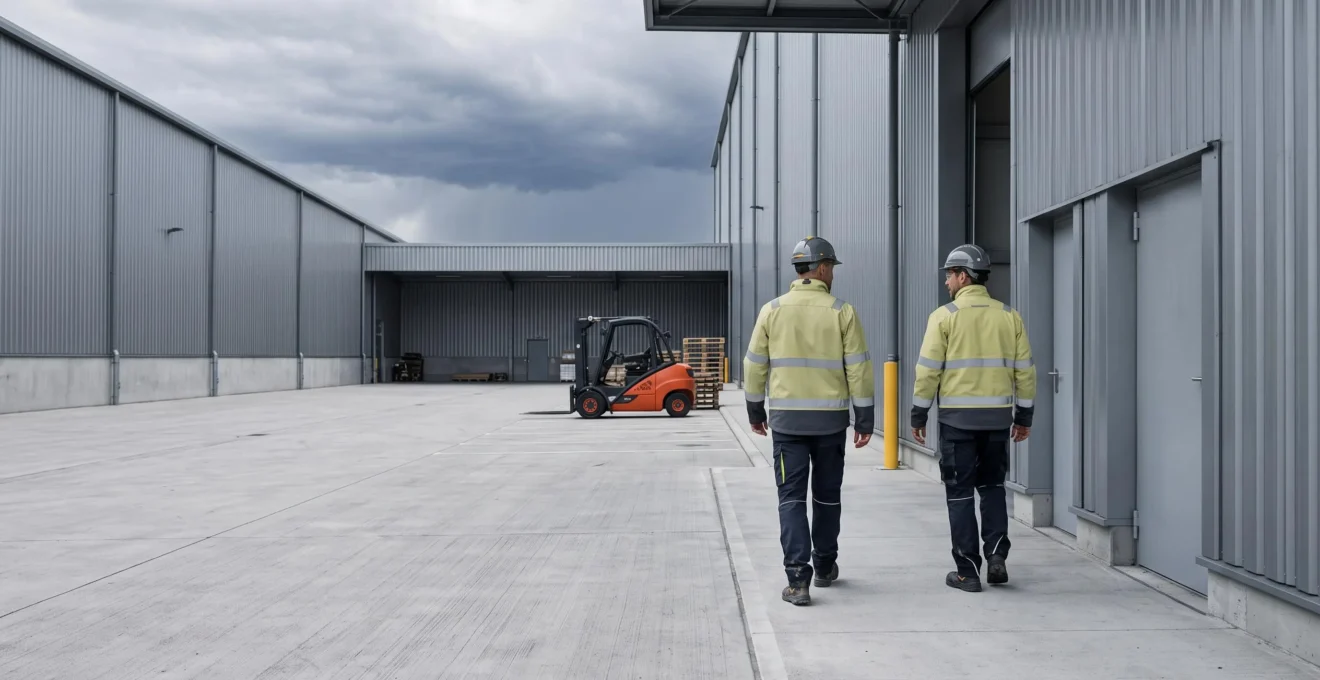
A warning-zone layout is useful only if it works for the people and operations it covers. Test actual response times, including the workers farthest from shelter, and update the arrangement whenever activities, structures or access routes change.
- Map every exposed work location and its accessible shelter.
- Test realistic shelter travel and equipment shutdown times.
- Confirm who receives warnings on every shift.
- Include contractors, visitors and temporary work areas.
- Provide backup communications and clear stop-work authority.
- Document all-clear responsibility and operational restart checks.
- Review zones after changes to equipment, access routes or activities.
US meteorological and workplace safety guidance provides a useful foundation for these decisions. Sites in other English-speaking countries should also check the applicable local safety requirements and weather-service recommendations rather than assume that every US procedure is legally binding elsewhere.
The best warning-zone layout is the one that can be implemented reliably under real operating conditions. Its boundaries should reflect exposure, provide sufficient time for protective action, keep workers informed and support a controlled return to work. Accurate mapping, accessible shelter and tested procedures matter more than choosing a single impressive-looking detection radius.